Published December 23, 2021 11:15AM
The Hike Forever Fitness Plan: How to Work Out
Get trail-fit fast! This 4-week program was designed specifically for hikers by trainers Melissa Racouillat of San Francisco's Stone Clinic and Darren Flagg of Boulder's Animal Strength Human Performance Lab.

'Thoroughly Reviewed'
Backpack for life with the Hike Forever Fitness Plan
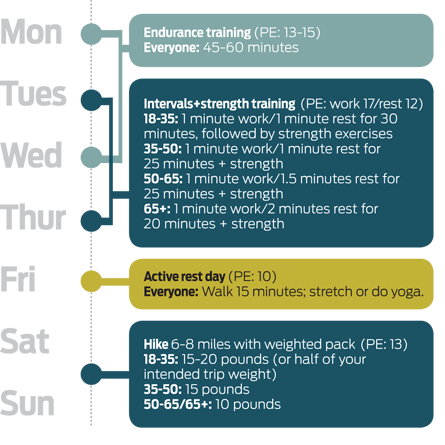
Week One: Create a base
Starting with moderate fitness, you’ll need just a week to build a strong foundation. Do endurance and interval work on a soft surface, like grass or a dirt trail, or with low-impact sports like cycling. Older hikers: Substitute brisk walking for running on endurance days.
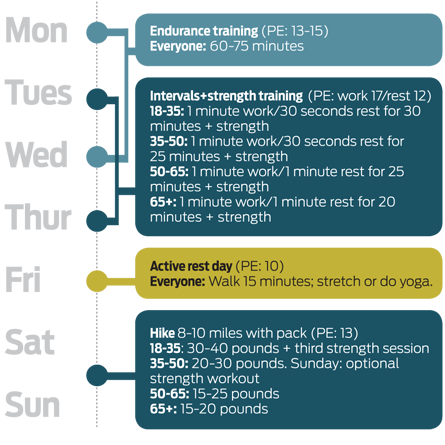
Week Two: Build power
High-intensity bursts build strength for steep climbs. This week, you’ll fit more into a half hour with longer intervals and less rest. Increase weight during training hikes to strengthen ankles and knees. For a lower-impact workout, substitute 1/4- to 1/2-mile swims for running.
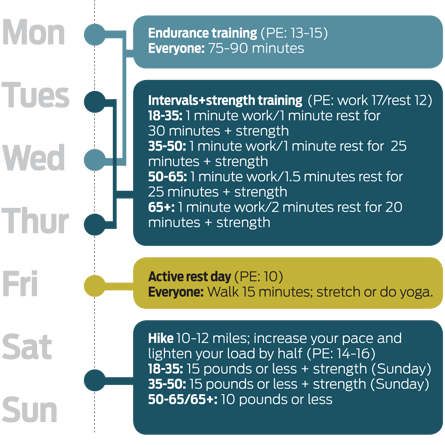
Week Three: Make Miles
Training over long distances increases endurance, and working eccentric muscles (those employed on the downhills) will prevent soreness later. Increase mileage on all distance training, but ease off interval times to recover from week two.
ADVERTISEMENT
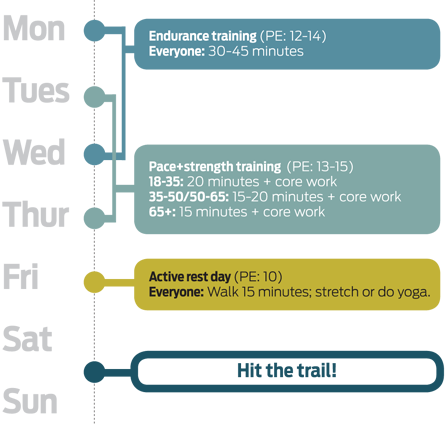
Week Four: Taper Off
Reduce intensity to preserve energy for the first day of your trip. Do endurance workouts on flat terrain, and substitute pace training (consistent tempo and intensity) for intervals. Stop lower-body strength exercises, but continue working your core and upper body.
Perceived Exertion (PE): How Hard Are You Working?
Perceived exertion (PE) is a subjective rating of intensity: You judge how hard you’re working. Use a 10-20 scale, with 10 being a brisk walk and 20 an all-out sprint. Fitness gains roll in between 13-15 for endurance; 16-18 for backpacker-beneficial intervals. Heart rate correlates to PE x 10.
- 20: Maximal exertion (power zone; gasping for breath; briefly sustainable)
- 19: Extremely hard (power zone; extremely labored breathing; sustainable 1-2 minutes)
- 18: Extremely hard (interval zone; labored breathing; sustainable 2-5 minutes)
- 17: Very hard (interval zone; labored breathing; sustainable 5-10 minutes)
- 16: Very hard (advanced endurance zone; heavy breathing; sustainable 15-30 minutes)
- 15: Hard (advanced/intermediate endurance zone; moderate breathing; sustainable 30-45 minutes)
- 14: Hard (intermediate endurance zone; light/moderate breathing; sustainable 45-60 minutes)
- 13: Somewhat hard (beginner endurance zone; light/moderate breathing; sustainable 60 minutes)
- 12: Somewhat hard (rest-between-intervals zone; breathing is light)
- 11: Light (rest-between-intervals zone; breathing is mostly unrestricted)
- 10: Very light (warm up/cool down; breathing is easy)
Last updated December 2021