Updated July 7, 2025 08:05PM
Why Your Shoulders Hurt When You Go Backpacking and How to Fix It
Those familiar aches that arise from hauling a heavy pack can force you into bad posture and take all the fun out of hiking. Fight load fatigue by strengthening the muscles that surround your spine, hips, and shoulders

(Photo: Suparat Malipoom / EyeEm via Getty Images)
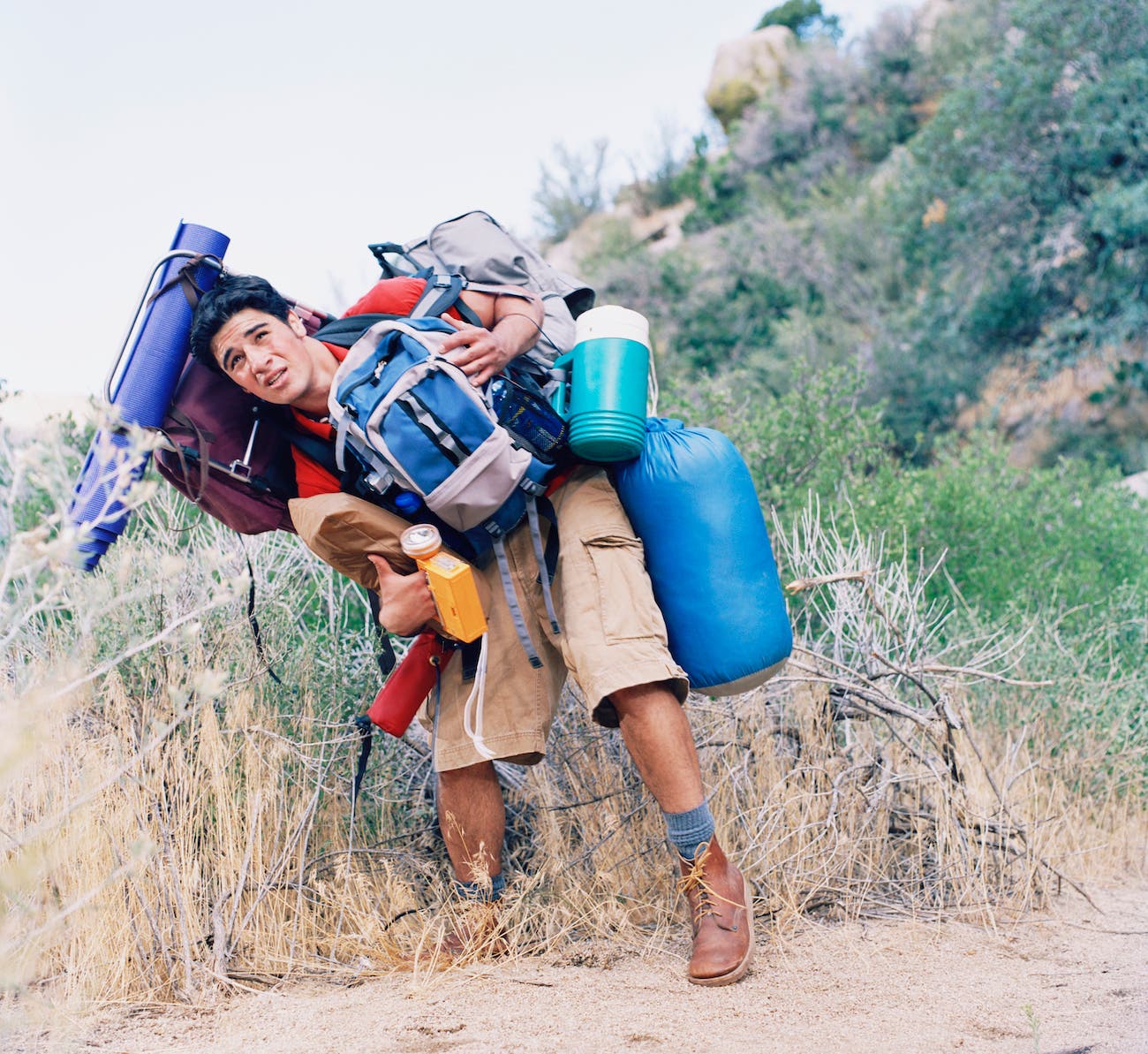
No matter your pack weight, wearing a backpack puts unnatural pressure on your joints and muscles. When you’re hauling a heavy pack for days at a time, it’s no surprise that your back and shoulders bear the burden. Soreness is a part of backpacking, but you shouldn’t be wincing at the thought of sliding on your pack. You can train your shoulder and back muscles for miles and miles of pain-free hiking.
Causes of Shoulder Pain
Wear your pack incorrectly for days on end, and you body will let you know. If your pack weight is making you lean forward, it’s no wonder you’re feeling shoulder and back pain: That unnatural posture is straining muscles in your neck, back, and shoulders. Intense activities like backpacking can also reveal any underlying muscle weaknesses. You might think that you just have to train your legs and glutes for a trip on the trail, but if you’re skipping your core, back, and shoulders, you’re setting yourself up for an achy sufferfest after a couple days.
Lack of flexibility around your trunk can also be a cause to shoulder and back pain. Yoga can provide relief; make time at your campsite to stretch out your muscles at the start and end of each day. Because the shoulder is the most flexible joint in the body, stretching the whole area regularly lets you move easy on the trails.
Adjust Your Backpack to Prevent Shoulder Pain
Your backpack could surely be the culprit to your back pain. It could be too heavy, or it could just not be fitting right.
ADVERTISEMENT
Your pack shouldn’t exceed 25-30% of your body weight. Before you hit the trailhead, be sure to examine what’s in your pack; finding ways to lighten your load makes your muscles happy. Ounces become pounds, and after a couple days on the trail, unnecessary pounds can lead to back and shoulder pain. Also, make sure to distribute your pack weight in a way that your shoulders aren’t getting pulled down by weight. Your sleeping bag goes in first, then pile on your lightweight items, like your camp clothes. Then go in your heaviest items, like bear canisters full of food; a large portion of your pack’s weight (including water bladders) should be centered between your shoulder blades and close to your back. To finish, fill in the rest of your pack with middle-weight gear (first-aid, stove, water filter, etc.) further away from your back and wherever there are gaps in your pack. The pack should have an equal weight distribution on the left and right side; it’s nearly impossible to have good posture when you have weight forcing you to lean one way or the other.
Consider buying your pack in person, at a store with an experienced staff who can help you fit your new purchase (you could wear a small in one brand and a medium in another; there’s not a brand-universal kind of sizing for packs). To get an accurate fitting pack, slip your arms through the shoulder straps, and cinch the hipbelt tight, making sure it’s tightened evenly with the buckle is in line with your belly button. Now, pull down on your shoulder straps until they’re snug, but not overly tight. You shouldn’t feel any constriction in your armpits, and your hips should be supporting most of the weight.
When To See a Doctor About Shoulder Pain
So, you’ve tried at-home remedies, rest, ice, and over-the-counter pain medications, but it’s been a couple weeks, and your shoulders still bother you? It’s time to get some medical help.
ADVERTISEMENT
If your shoulder joint looks deformed, starts swelling, loses feeling, or develops new or intense pain, visit your doctor immediately. You should also schedule an appointment if you start feeling tenderness, redness, or warmth around the joint.
Shoulder Pain Relief Exercises
You don’t have to hang your pack up for the rest of the season if you’re proactive. Prevent muscle imbalances and weaknesses with these strengthening exercises from Kaelyn Silva of Pasadena Sport Science.
Potato Chips
Develop your postural muscles, which help resist the backward pull of a weighted pack.
Reps: 20 Sets: 3
- Lie on your stomach, resting your head in a comfortable position. Reach behind you and touch the backs of your hands together (or as close as you can get) over your lower back, with your thumbs up.
- Engage your core muscles and raise your hands away from your sacrum as high as your shoulders allow. Lift your legs off the ground a few inches, keeping your knees straight. Raise your head slightly, eyes focused forward.
- Hold for 5 seconds. Release and rest for 3 to 5 seconds before repeating.
ADVERTISEMENT
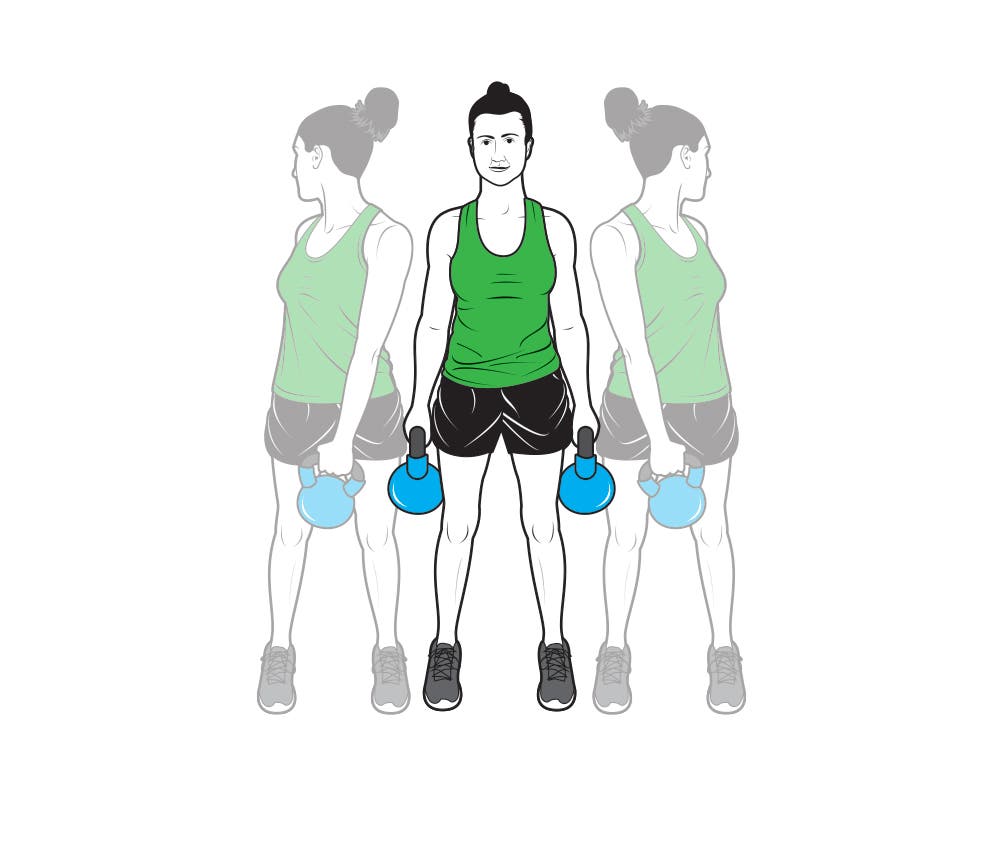
Torso Rotations with Kettlebells
Engage your core in multiple planes to simulate moving over uneven terrain.
Reps: 10 per side Sets: 3
- Grab a pair of kettlebells, starting with a comfortable weight and building up as you get stronger to a combined amount that’s slightly heavier than your overnight pack.
- Stand with your feet a few inches apart, knees slightly bent. Tuck your tailbone under you so that your pelvis is in a neutral and level position.
- With your palms facing in, use momentum from the kettlebells to swivel at the spine until your shoulders are facing 90˚ to the right. Return to center, and twist to the left. Stand tall and rotate only above the waist.

Tic-Toc
This exercise trains you to breathe properly while activating your load-carrying muscles.
Reps: 8 to 10 per side Sets: 1 to 3
- Sit on a firm bench or plyo box (your knees should make right angles). Grab a dumbbell that feels challenging, but won’t compromise your form (10 to 30 pounds). Orient the weight front to back. Set your feet hip-width apart, distributing the weight evenly on your sit bones and feet. Check that your pelvis is not tilted.
- Lift the weight directly overhead, arms nearly straight. As you exhale, lean slowly to the left, as far as you can without tilting your pelvis. On the inhale, return to center, and repeat to the right.
ADVERTISEMENT
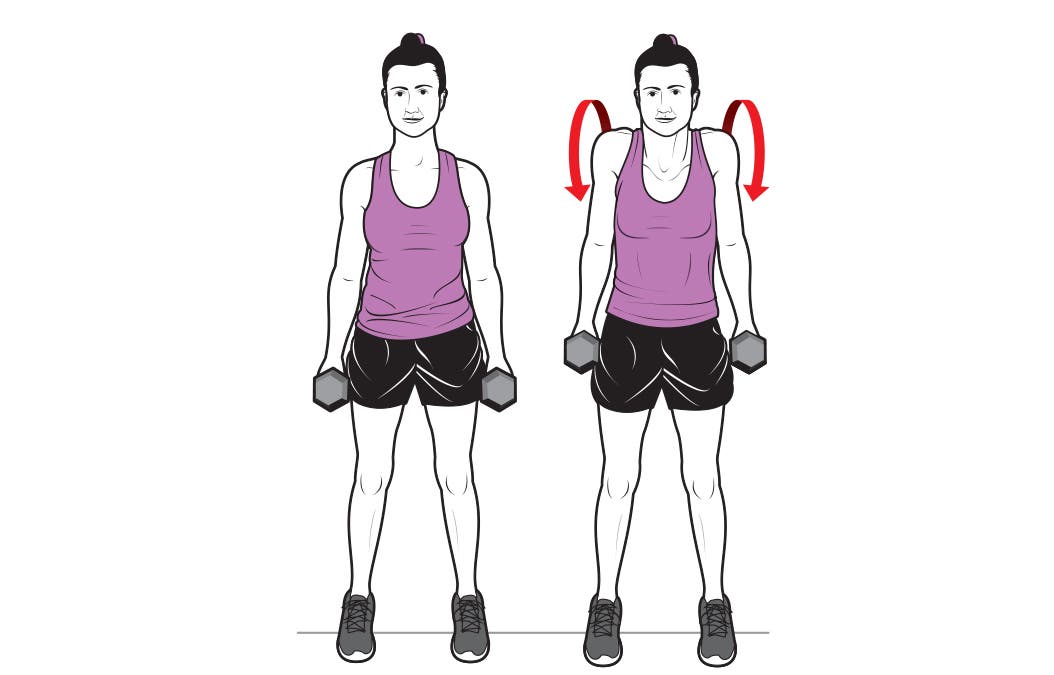
Loaded Shoulder Rolls
As the miles pass, we tend to let our shoulders droop forward. This exercise builds strength to keep your shoulder blades properly positioned.
Reps 10 each direction Sets 3
- Hold a 10- to 20-pound dumbbell, kettlebell, or similar weight in each hand.
- Stand up tall with your feet hip-width apart, knees slightly bent, and arms at your sides. Grip the weight so your palms face your thighs.
- Pull your shoulder blades back toward your spine as you push your breastbone forward.
- In a slow, fluid motion, lift your shoulders up, then forward, then down, emphasizing the diameter of the circle you are creating. Complete 10 circles, then switch directions.
The Expert
Kaelyn Silva, CSCS, is the owner of Pasadena Sport Science. When she’s not training others, she enjoys loading up her pack and hiking with her dogs to peak-rimmed Thousand Island Lake in the Ansel Adams Wilderness.