Updated June 16, 2025 04:30PM
How to Choose a Knife, According to a Survival Instructor
Blades come in all shapes and sizes. Here's how to pick the right one for your needs.
(Photo: Alex Ratson/Getty)
In her monthly column, The Survivalist, Jessie Krebs writes about self-care and safely getting out of the occasional rough backcountry scenario. Krebs is a former Air Force S.E.R.E (survival, evasion, resistance, and escape) instructor and owner of O.W.L.S. Skills.
A knife is very useful for survival, but it’s easy to go down the rabbit hole when it comes to style, blade length, metal type, brand, and so on. There are hundreds of knife variations on the market, and, like a lot of equipment, once in a rare while some new innovation really does make a knife better. Most of the time, though, they turn out to be gimmicks that sound or look good, but lack practicality. Here’s what to look for when picking out a knife for your survival kit.
Types of Knives
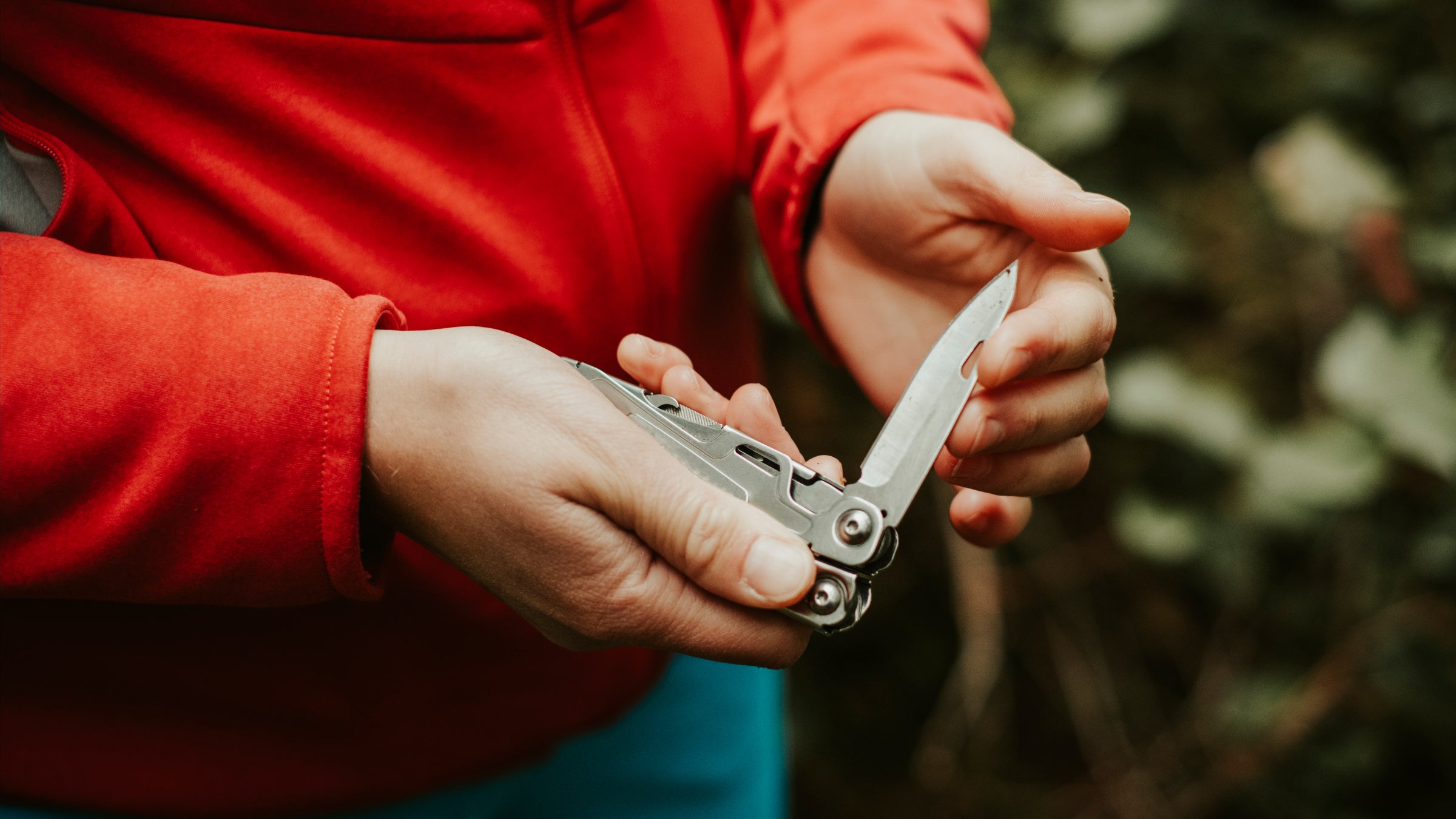
There are two types of knives commonly used in survival and outdoor applications: a folding blade, often incorporated into a multitool, and a fixed blade that requires a sheath to protect the cutting edge (and you) from damage. Folding blades tend to be smaller and, due to weakness at the pivot point, they are not meant for heavy duty work such as chopping or batoning, which is better left to a fixed blade. Folding blades are better for carving, making feather sticks and shavings, and fine detail work. Any cutting tool is better than none. A simple straight-razor covered in protective cardboard, soaked in olive oil to prevent rusting, and wrapped in packing tape is a third of the size of a credit card and a great backup blade.
ADVERTISEMENT
Knife Quality
A quality fixed blade should have at least a three-quarter tang. This has nothing to do with the orange fruity drink: The tang is the part of a fixed blade knife that extends into the handle. Full tang knives have continuous metal the same thickness as the spine that extends throughout the entire handle, resulting in a stronger tool. Often, knife-makers will leave the tang exposed and attach two pieces of wood, bone, or antler (called scales) for a comfortable handle. Partial tangs, on the other hand, have metal that tapers and/or extends only partway into the handle. I’ve had several partial (half or shorter) tangs snap or separate from the handle under strain.
A quality folding blade should not have any wiggle between the handle and the blade when it’s open and should feel solid. A locking folding blade is generally stronger than one that doesn’t lock into position. I also recommend avoiding folding knives with quick-opening levers. These often stick out, making it difficult to hand sharpen, and they are more likely to open accidentally.
Blade Composition
Steel blades will be some variety of either stainless or carbon. Kitchen knives and folding knives (or pocket knives) are almost exclusively made of stainless steel because it resists rusting. However, stainless steel is also very hard and thus brittle, meaning it tends to chip and snap if hit hard or bent. If you see a knife with a missing tip, it’s most likely a stainless steel knife. Carbon steel, on the other hand, tends to be “softer,” thus more flexible and springy. High carbon steel edges don’t chip, but rather flatten, and can be reformed fairly easily. Carbon steel must be protected from prolonged wet conditions or it will rust. If you don’t want to carefully clean and dry your knife with every use, or you’re going into a wet environment, stainless steel may be best for you—just be gentle with it.
ADVERTISEMENT
Grip
A good grip is important. Many knives marketed for outdoor use feature belt clips. It’s best to avoid these: The sharp edges on the handle dig into your hand, creating blisters with as little as 10 minutes of continuous use. I look for rounded edges and a comfortable, smooth (but not slippery) grip. If you don’t work with knives often, look for one with a good guard to reduce the risk of injuries.
Bevel Style
The bevel of a knife refers to the angle and shape of the metal closest to the edge. It’s also called the grind.
ADVERTISEMENT
For a fixed blade, I prefer a flat grind, meaning the bevel forms an even V shape. Fixed blades are generally for hard impact work (I use mine most for batoning), so having a nice V to split things down the middle and stay centered is important.
I also love a chisel grind (one side of the bevel is flat, the other angled); I barely need to angle my hand and wrist to peel off wood when carving, and it wants to dive into the material with minimal effort. However, 90 percent of chisel grinds I see are for left-handed folks when about 89 percent of the population is right-handed. To check if a chisel grind is right for you, the flat side should be toward you when held in your dominant hand. If not, all advantages of this type of grind are lost. I only have this type of grind on my multitool since a chisel grind is best for peeling layers off, not splitting wood.
Unless you’re only cutting bread, skip serrated blades. They might look cool, but they’re not practical for wilderness uses.
Accessories
Some multitools have so many implements they are too big to fit into a pocket and the tools are hard to access. Keep it simple; you won’t use nearly as many as you think you might. I recommend looking for a multitool with 10 tools or less. My favorite is a 4-inch stainless steel multitool that includes a right-handed chisel-bevel knife blade, saw, awl, can opener, and tweezers.
Lanyards are awesome—it’s hard to use a knife you can’t find. Knives without a way to attach a loop or bright lanyard of some kind are asking to be lost. Even better if I can attach the sheath to the handle of a fixed blade knife with a length of paracord.
ADVERTISEMENT
A Survivalist’s Knife Quiver
If I’m going to be out for a while and want lots of flexibility, I like to carry three knives: a very small (2.5 inches or so) stainless steel multi-blade pocket knife for whittling, crafting, and fine detail work, a medium (4-inch) stainless steel multi-tool, and a medium length (4-inch), thin, high-carbon, fixed blade for batoning and general heavy lifting. Very rarely will I need a larger machete-type blade. Keep in mind legality, safety, and maintenance concepts when choosing and using knives.