Published July 13, 2000 12:00AM
Virginia's False Cape State Park
Near-complete isolation just a few miles from Virginia Beach.
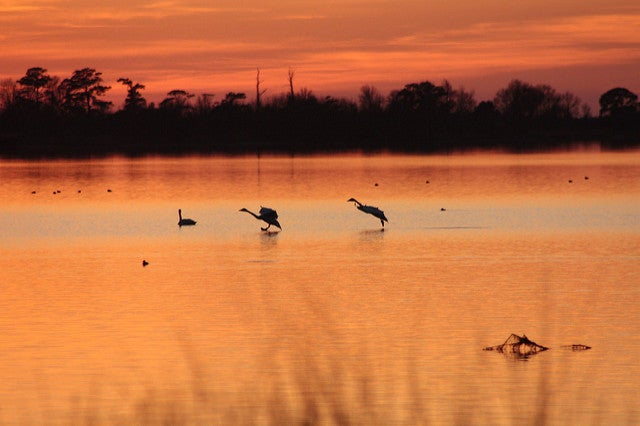
'Back Bay at sunset. Photo by: Virginia State Parks'
Virginia’s False Cape State Park is one of the few places where you can camp right on the beach without a dune between you and the water. The park lies just a few miles south of the state’s major seaside resort, Virginia Beach, but those few miles make a world of difference.
Between the town and the park lies Back Bay National Wildlife Refuge, a four-mile stretch of beach and marsh where motorized vehicles are not allowed. Then it’s six miles to the campsites. You can hike, bike, or canoe. Mountain bikes or fat-tired beach bikes are recommended, but we made it on touring bikes.
There are three routes through the refuge: the beach, the east dike, and the west dike. The west dike is the least sandy. And the beach is the easiest walking in the world at low tide and the hardest in the world at high tide.
A hiking-biking trail runs south through the forest, with periodic side-trails to the beach. South of the park, this spit of land continues as North Carolina‘s famous Outer Banks.
Two full miles of the cleanest beaches you’ll ever see permit camping here, so you can be as isolated as you want. A few people have permits to drive down to their land in North Carolina, and periodically a ranger motors past, but that’s about it for civilized intrusions.
ADVERTISEMENT
Visit False Cape State Park
Contact Information
False Cape State Park
4001 Sandpiper Rd.
Virginia Beach, VA 23456
(804) 426-7128
Location
False Cape State Park is in the southeast corner of Virginia, just a few miles south of the seashore resort Virginia Beach.
ADVERTISEMENT
Getting There
From Richmond, take I-64 east. In Virginia Beach, follow U.S. Rt. 60 to Seashore State Park. Stop here for permits and directions. To get to False Cape, you must park at Little Island Recreation Area (with a permit) and walk five miles. You also have to pass through Back Bay National Wildlife Refuge on your way. There is also a canoe launch near the parking lot.
Seasonal Information
What’s best? Summer for swimming, any other time for wildlife except the week beginning the first Saturday in October, when the park is closed for deer hunting. Spring and fall, with temperatures ranging from 50 to 80 degrees F, are good times to backpack. Summer temperatures can reach into the 90s, with chances of thunderstorms and the strong likelihood of bugs. In winter, the temperatures rarely drop below 30 degrees F.
Wildlife
The trip is beautiful, through the high grasses of the refuge’s marshes, where egrets, herons, ibis, and other waterbirds feed. In the winter, the refuge hosts migrating waterfowl: swans, ducks, and geese.
ADVERTISEMENT
The park and refuge are homes to deer and feral horses and pigs. You might also see dolphins just yards offshore and a cottonmouth moccasin slither across the trail, then swim into the marsh.
Insects
“Countless biting insects,” warns a sign on the way in.
Plant Life
While the refuge is mainly marsh behind the dunes, the park contains the many ecosystems of a barrier island: beach, then dunes with sea oats, then scrub, then loblolly pines and live oak, before dropping again into the shallow waters of Back Bay.
False Cape Facilities
Primitive camping is available at 12 campsites. Reservations must be made through:
First Landing/Seashore State Park
2500 Shore Drive
Virginia Beach, VA 23451
(804) 481-4836; (804) 721-2412, during December, January, and February
Bikes can be rented at Ocean Rentals ((804) 721-6210).
ADVERTISEMENT
Permits
Camping permits ($8 per night for a maximum of six people) are available at Seashore State Park. There are also fees of $2 per person to bike through the refuge and $4 per vehicle to drive a half-mile and then park, but that parking lot is for daytime use only. Permits must be obtained in person by 3 p.m. of the day of your reservation at:
Seashore State Park
2500 Shore Drive
Virginia Beach, VA 23451
(804) 481-2131
ADVERTISEMENT
Policies
- Pets are allowed on a leash; however, pets are prohibited through the refuge on a seasonal basis (April 1 to September 30). For more information, contact the refuge at 804/721-2412.
- Camping is limited to 14 nights in any 30-day period.
- No open fires or charcoal grills are permitted.
- Since access to False Cape is through Back Bay National Wildlife Refuge, all visitors must comply with the refuge’s guidelines. Be aware that you may be on the refuge property during daylight hours only, so plan your trip accordingly.
Hazards
- Bring extra-long tent stakes for beach camping.
- Don’t expect any shade — bring a tarp, wide-brimmed hat and lots of sunscreen.
- Haul in all your drinking water; no potable water is available. A gallon a day per person is recommended.
- Watch for cottonmouth moccasins if you step off the trails.
- There is no vehicular access to the park.
Leave No Trace
- Stay on designated trails and beach.
- Stay off the dunes.
All LNT guidelines apply.
Maps
Simple maps are available at Seashore State Park and at the refuge. Topos aren’t needed.
Other Trip Options
- Virginia Beach Marine Science Museum (804/437-4949) is an excellent place to visit.
- There are also bike trails at Seashore State Park.
Little-Known Fact: To get to False Cape State Park you must pass through Back Bay National Wildlife Refuge.