Published October 10, 2016 07:38PM
How to Master Your Trekking Poles
Trekking poles reduce impact on joints and help prevent falls on tricky terrain—but only if you use them right. Jayah Faye Paley, creator of training seminars and materials on the topic, offers these tips for getting the most out of your sticks.
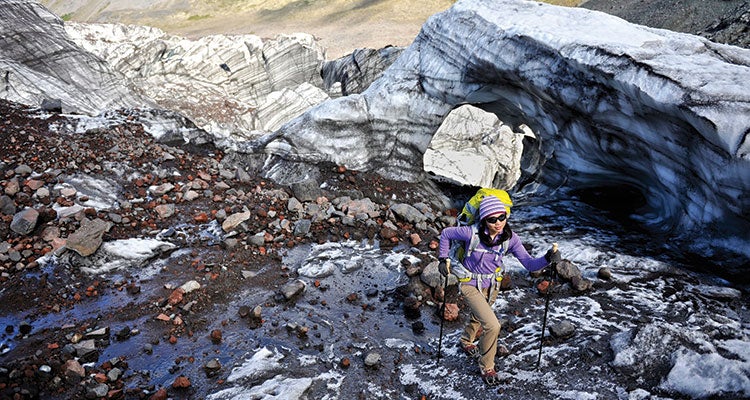
'Plant pole tips at a 90-degree angle to reduce slipping on slick surfaces, like this icy terrain in Wrangell-St. Elias National Park. Photo by…'
Use both poles.
Using a single trekking pole can create strain on one side of the body and compromise balance.
Hold them correctly.
Bring your hand up through the bottom of the loop, then straight down on top of the strap, so it lays smoothly across the back of your hand. Avoid gripping the poles tightly, which can create strain all the way up your arm to your neck.
Customize length.
Conventional wisdom suggests that on even ground, arms should bend at 90 degrees when you’re holding poles, but this isn’t always best for everyone, Paley says. It’s more important to be comfortable than to go for a perfect right angle.
ADVERTISEMENT
Adjust length as you go.
Make them shorter on uphills and lengthen them for downhills.
Plant poles carefully on slick terrain.
Position poles straighter up and down, because angled poles tend to slip more easily.
Descend safely.
On steep, off-trail terrain, use poles to ease your weight down so you’re not jumping onto uncertain footing.
ADVERTISEMENT
Make stream crossings safer.
Lengthen poles for deeper water, and make sure pole tips are planted securely on the river bottom.
Keep it natural.
Poles do the most good if you continue to walk naturally. Let your arms swing normally.
Engage your core.
Don’t simply move your arms back and forth. Keep your core involved, as this helps take further pressure off of your knees.